creative thoughts in gastronomy. Expand your educational horizons
CHEF ANDRE' CHIARINI' WEB SITE
THE FALSE HISTORICAL STORIES IN GASTRONOMY


SUBJECT
(at the end you will find the booklet to download for free)
Literature is full of fakes. Generally they are always things of authors of past eras, but also of almost contemporary authors is written under pseudonym to invent the life of a non-existent author.
Other forgeries are secret diaries and even philosophical works, reconstructed posthumously after the author’s death, thanks to notes. Even in science it happened in an era where there were no revisions of the texts (the so-called peer reviews) and academic articles were published in good faith.
The painting and the sculpture have been full of very skilled forgers able to scam the art market.
There were then painters who probably used the fake. Giorgio de Chirico’s paintings, according to his first wife Raissa Gourevich, would be divided into categories.
In gastronomy the question is not different but is more complex. How a recipe is born and what it means traditional or historical. The same can be for a product.
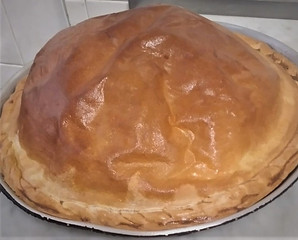
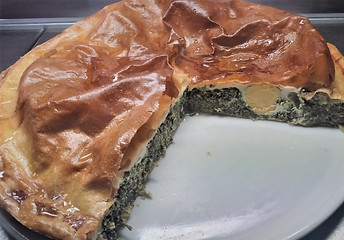
In the lesson I will give you the example of a savory cake, typical of my city of birth, Genoa. This cake has become famous as Pasqualina cake.
The Pasqualina cake is traced back to another cake called "gattafura", a vegetable cake with cheese.
Often dates and authors are reported in a confused way, crossing them incorrectly, which of course are repeated until they become truth. Here we retrace as much as possible a precise story.
From the Pasqualina savory pie we will pass to another very similar savory cake, born in Reggio Emilia almost certainly as a poor food, it is gradually embellished with excellent products of Emilia.
The art of filling vegetables is on the other hand typically Ligurian but again also Provencal.
In the province of Imperia there is the recipe of the green savory pie, which is based on the same dough of barbagiuai (in Ligurian dialect - barbagiuàn in the singular), species of fried ravioli. The French fried ravioli call them tourtons but the Provençals give them the name of barbajuan, while in the Principality of Monaco it is called as in the Ligurian dialect. In Liguria there are also vegetables stuffed or stuffed with vegetables, which of course are also made in Nice and surroundings, called petite farcies or small fillings.
Genovese basil pesto is a recipe that is only 150 years old, from what is documented.
Having spoken of France I will cite some French recipes very well known with their documented origins.
These are only the first written testimonies of the mentioned recipes and we refer to these dates, because history needs certain references, if you do not want to turn it into a fairy tale.
I will briefly recount the poverty of Europe after the fall of the Roman Empire and its slow and tiring rise from hunger.
With chickpeas you can make a very long journey that traces these phenomena, from India, to the Middle East and Mediterranean Europe and I will briefly do it with you, because a simple product of the earth is able to involve many populations.
I will quote Prof Alberto Grandi and his book that years after its publication caused a sensation in Italy.
The history of Parmesan cheese is millenary but this does not mean that what we eat today is identical to that of the year 1200 as seen from the image of an advertisement of about 1800.
The history of gastronomy is never 100% certain, since the origins of a dish with a precise recipe per gram do not exist. Moreover no recipe is ever as old as you think.
Certainly many recipes and products have been handed down orally before being formally transcribed, but they have also been transformed, both for events of political, military and social history, for issues of proximity between borders of provinces and/or nations, and changes in finding ingredients. However, selling recipes or products as secular, as I show, is only a matter of economic needs, such as marketing and advertising that has nothing to do with the historical reality of the facts.
What certainly happens is that everyone traces the origins of a recipe to their own nation or territory. For many, food is a kind of patriotic pride, even if they are always the result of a meeting between different peoples.
In summary what we eat today is not exactly what it was and often does not look like him at all. In short, the origins of recipes and products are the result of a continuous mixing and reinterpretations over time.
At this link of the site you can download many ancient recipes